
What Happens in Your Brain When You Get Triggered? (And Why You Feel Like a Different Person)
“Why did I react like that?”
Maybe it was something small—a tone of voice, a text, a comment—and suddenly you felt way more activated than the situation seemed to call for.
Afterwards, you might think: Why did I react like that? That’s not even me.
If this has happened to you, you’re not alone.
And more importantly—there’s a really good explanation for it.
A simple way to understand your brain
Dan Siegel uses something called the hand model of the brain to explain what’s happening when we get triggered.
You can even follow along with your hand:
Your wrist and palm represent your brainstem (basic survival functions like breathing, heart rate)
Your thumb tucked into your palm represents the limbic system (emotions, memory, threat detection)
Your fingers folded over the thumb represent the cortex (thinking, decision-making, empathy)
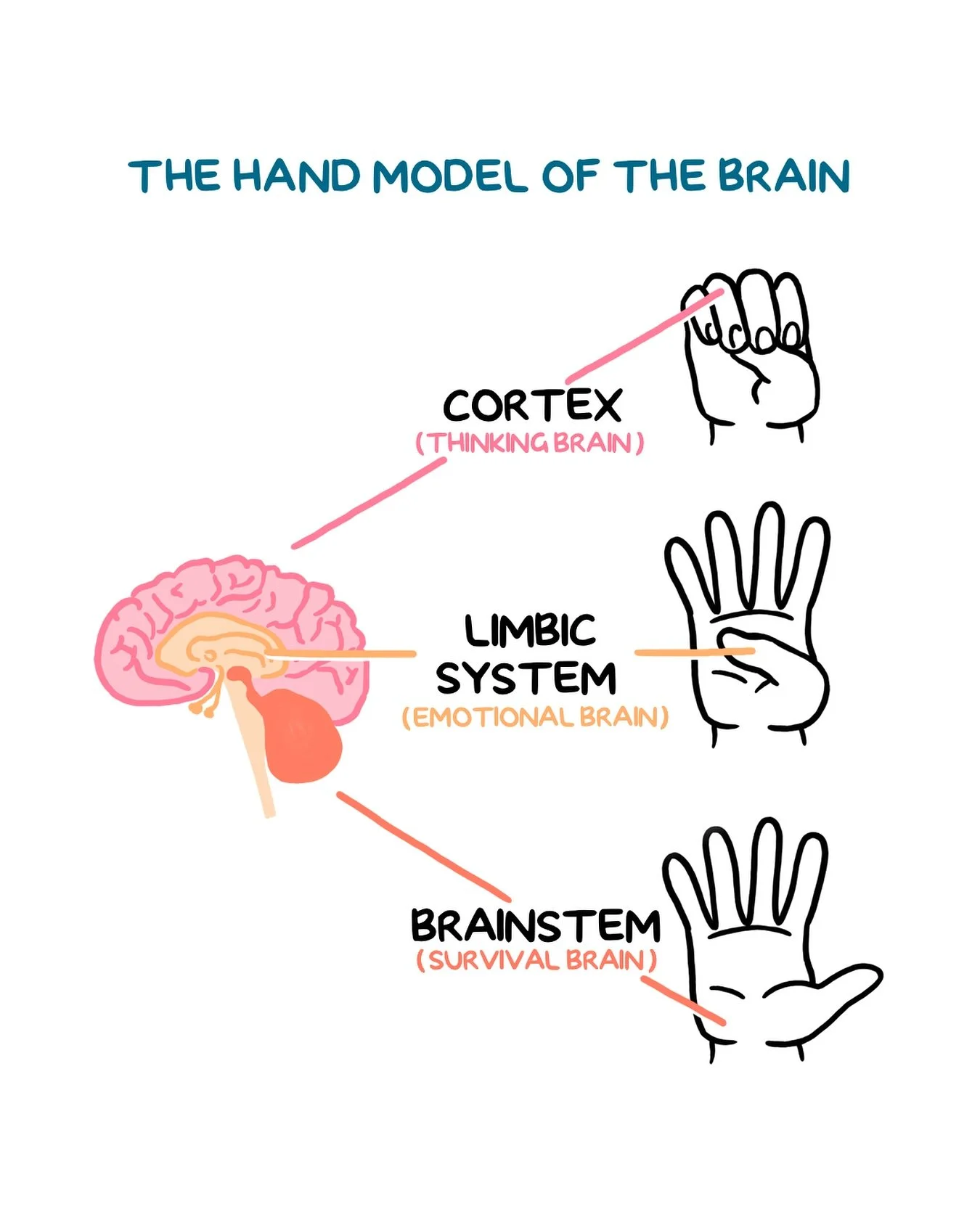
image from @adriana_draws_therapy
When your fingers are folded over your thumb, your brain is integrated.
Everything is working together.
What it means to “flip your lid”
When you get triggered, your brain perceives something as a threat—based on your past experiences, not just what’s happening in the moment.
And then something shifts.
In Siegel’s model, your fingers (cortex) lift up—this is what he calls “flipping your lid.”
What that means in real life:
Your cortex goes offline
The emotional part of your brain becomes more dominant
Your body shifts into survival mode
And your cortex is responsible for things like:
Critical thinking
Decision making
Empathy
Perspective-taking
Emotional regulation
So when it’s less available, it makes sense that:
You say things you wouldn’t normally say
You feel reactive or overwhelmed
You struggle to think clearly
You feel like a completely different version of yourself
This is why it feels so intense
When your “lid is flipped,” your brain is prioritizing survival, not connection or logic.
Your system is asking: Is this safe? Do I need to protect myself?
Not:What’s the most thoughtful response here?
This is why trying to reason with yourself (or someone else) in the middle of a trigger often doesn’t work.
It’s not that you’re unwilling.
It’s that the part of your brain that helps with that isn’t fully online.
So what actually helps?
When your lid is flipped, the goal isn’t to immediately fix the situation or figure everything out.
It’s to help your brain come back into integration.
This can look like:
Pausing and noticing what’s happening in your body
Shifting your attention to something around you (grounding)
Giving yourself a bit of space before responding
Gently naming what you’re feeling (“I’m really activated right now”)
These small steps help bring your cortex back online.
What happens next
As your system settles, your brain starts to reintegrate:
You can think more clearly
You have more access to empathy (for yourself and others)
You can respond instead of react
You’re not becoming a different person, you’re coming back to yourself.
A gentle place to start
The next time you notice a strong reaction, you might try asking:
Did I just flip my lid?
What does my system need right now?
Even that small moment of awareness can create a bit more space.
And over time, that space can change how you experience yourself, your relationships, and those moments that used to feel overwhelming.
If you want support with this, this is the kind of work I do with clients in Vancouver and across BC—helping you understand your brain and body in a way that actually feels useful in your day-to-day life.
FAQs about Being Triggered
What does it mean to be “triggered”?
It means your brain has detected something as a threat and shifted into a survival response.
Why do I feel like a different person when I’m overwhelmed?
Because your cortex (thinking, empathy) is less active, and your emotional brain is more in charge.
Can I stop myself from getting triggered?
Not always—but you can learn to notice it sooner and support yourself through it.
How do I “unflip my lid”?
By helping your nervous system settle—through grounding, pausing, and giving yourself time before reacting.
