
Why You Feel Settled, Overwhelmed, or Totally Checked Out: A Simple Way to Understand Your Nervous System

Photo by Madison Oren on Unsplash
A moment that might feel familiar
One of the resources I share with clients most often is a simple chart that maps out different nervous system states: feeling connected and okay, feeling overwhelmed and anxious, or feeling shut down and disconnected.
Today, a client looked at it and said, “I was definitely really anxious the past few weeks. But as of yesterday, I’m starting to feel more like myself.”
We talked about how that’s a sign they’re moving more towards their window of tolerance and what helped them get there. For them, it was getting back to their usual routines, feeling steadier at work, and being able to make sense of and move through some intense emotions.
Most of us were never taught how to notice what’s happening inside of us. We just know something feels off, but we don’t always have the language for it.
This is where this framework can really help.
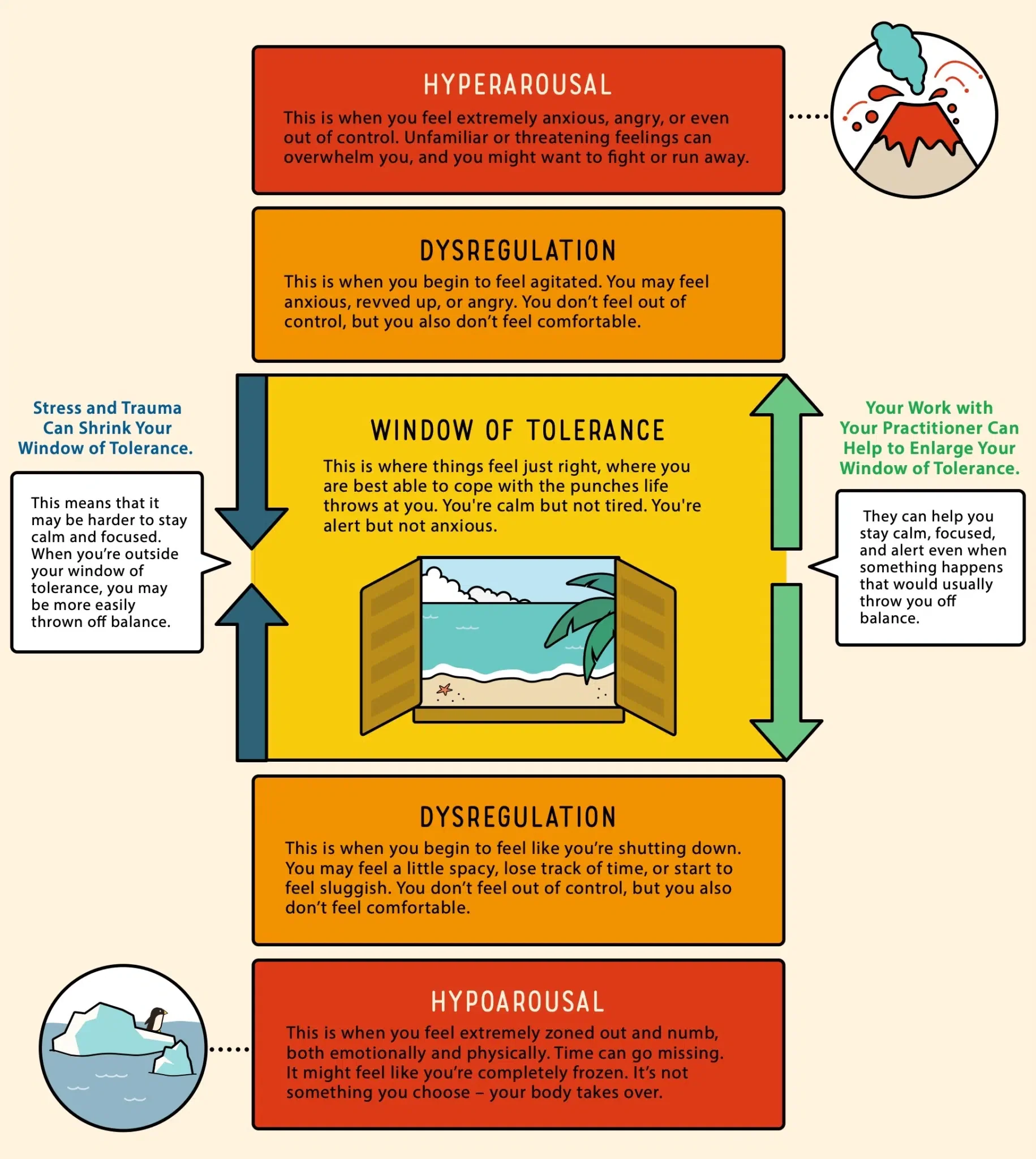
Image from brisbanecounsellingcentre.com.au
When you feel like yourself: your “window of tolerance”
In interpersonal neurobiology, we talk about something called the window of tolerance—a term associated with Dan Siegel.
This is the zone where your nervous system feels regulated enough.
You’re still going to feel stress, sadness, or frustration. But those feelings don’t completely take over.
You might notice:
You can think more clearly
You feel more like yourself
Your emotions move through instead of getting stuck
You can stay present in conversations and relationships
It’s not about being calm all the time. It’s about having enough space inside to handle what’s coming up.
When you feel overwhelmed: moving above your window
If you’ve ever felt anxious, reactive, or like your mind won’t slow down, you may be above your window of tolerance.
This state isn’t a personal failure or something you’re doing wrong. It’s your nervous system picking up on something that feels like a threat and it’s trying to protect you.
Sometimes that threat is obvious. Sometimes it’s more subtle, like conflict, pressure, uncertainty, or something that reminds your body of an overwhelming experience you’ve been through.
You might notice:
Racing thoughts or overthinking
Feeling irritable, reactive, or sensitive
Trouble relaxing, even when you have time
A sense of urgency, like you always need to be alert or “on”
Your system is trying to protect you by keeping you alert.
When you feel shut down: moving below your window
On the other side, you might find yourself below your window of tolerance—what we call a hypoaroused state.
This is more of a shutdown or disconnection.
Again, this isn’t something you’re choosing. It’s your system’s way of protecting you when things feel too overwhelming for too long.
Feeling numb, blank, or disconnected
Struggling to start things (even small tasks)
Low energy or motivation
Feeling distant from people, even ones you care about
This is your nervous system trying to help you by reducing intensity.
So what do you do with this?
The goal isn’t to judge where you are. It’s to notice.
You might gently ask yourself:
Am I within my window right now?
Am I above it, or below it?
Because each state has different needs:
Above your window → slowing down, grounding
Below your window → gentle movement, connection
Within your window → noticing what’s working
And here’s something really important:
Your nervous system is always trying to help you survive, even when it doesn’t feel good. And you can move toward your window of tolerance from any state, at your pace.
A gentle place to start
Maybe today, you just notice where you are once or twice. No pressure to change it.
Over time, that awareness can shift how you relate to yourself in really meaningful ways.
And if you want support with this, this is the kind of work I do with people in Vancouver and across BC—making sense of your experience in a way that actually feels practical and grounded in your day-to-day life.
FAQs about Nervous System Regulation
What is the window of tolerance?
It’s the range where you feel regulated enough to think, feel, and respond without becoming overwhelmed or shut down.
Why do I go between anxiety and numbness?
Your nervous system moves above and below your window of tolerance to protect you from overwhelm.
Can I expand my window of tolerance?
Yes, over time and with support, your capacity to stay within your window can grow.
Does being “in your window of tolerance” mean you’re healed?
No—it just means your system feels regulated enough in that moment.
